
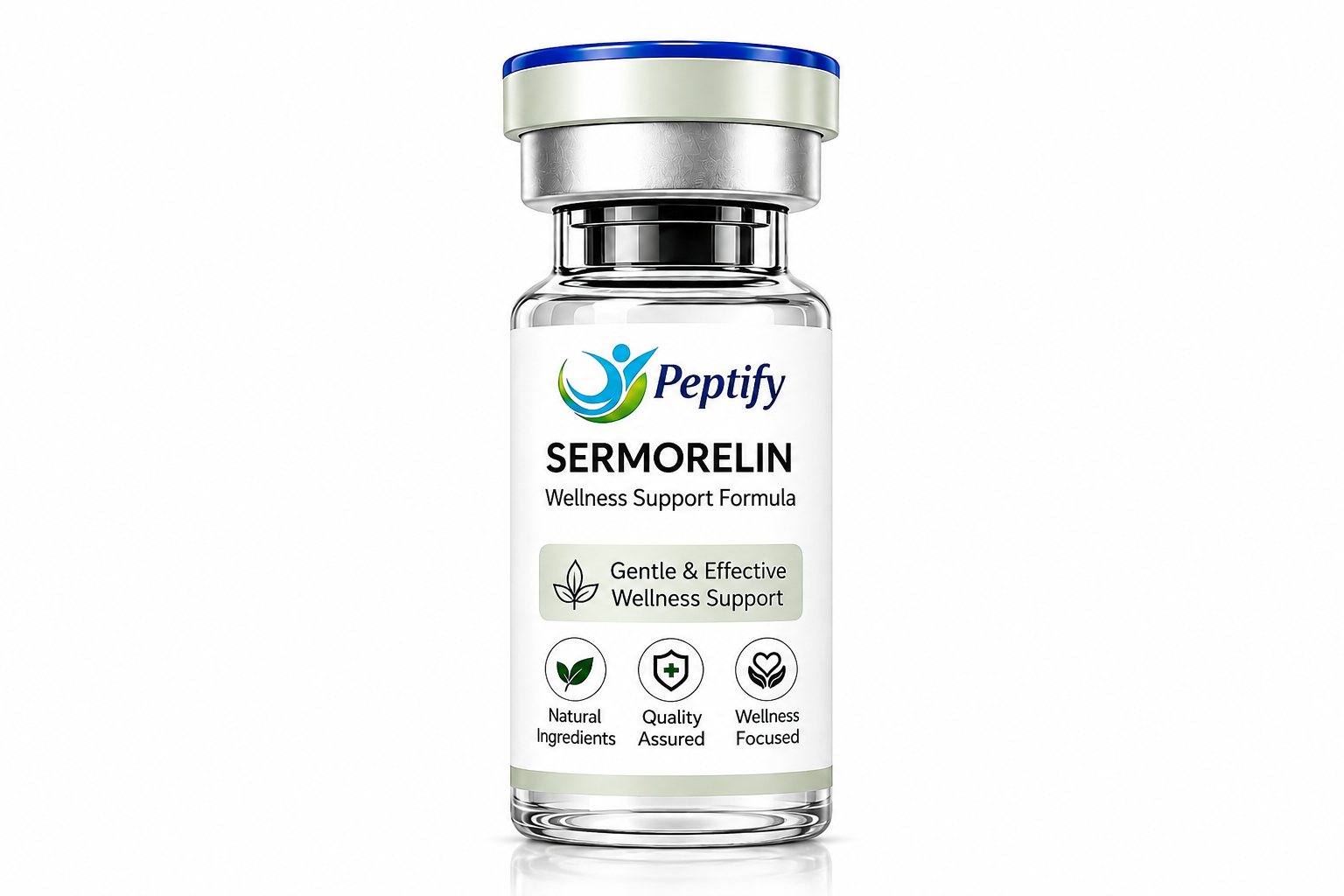
Sermorelin Acetate 2mg
A research-use GHRH-fragment entry for GH-axis review and clinician-led safety screening.
Contents
Use this guide as a structured review page. The same headings appear for every protocol so clients and the care team can scan the page consistently.
Important Note
This page is informational and does not authorize use. Peptify clients should complete assessment, disclose medications and health history, and follow the clinician-approved plan only.
- Do not start, stop, combine, or change a protocol based only on website content.
- Emergency symptoms require urgent medical care, not a website or routine follow-up message.
Quickstart Highlights
Sermorelin is a GHRH analog — a synthetic copy of GHRH(1–29), the active fragment of growth-hormone-releasing hormone — that stimulates the pituitary to release the body’s own growth hormone (and, in turn, IGF-1)[1][6]. This educational page outlines a once-daily subcutaneous approach dosed in micrograms at bedtime, with a dilution chosen so doses land on easy-to-read insulin-syringe marks. Sermorelin was once FDA-approved (brand Geref) for childhood GH deficiency, but that product was discontinued around 2008 and no FDA-approved sermorelin exists today; adult uses are off-label/compounded or research-only and are not proven by rigorous trials — presented for research and educational use only.
- Add 3.0 mL bacteriostatic water to one 5 mg vial → ~1.67 mg/mL (1,667 mcg/mL), the largest practical dilution for accurate microgram dosing.
- 100–500 mcg once daily at bedtime, titrated upward gradually toward ~500 mcg over an 8-week course.
- At ~1.67 mg/mL, 1 unit ≈ 16.7 mcg; 200 mcg ≈ 12 units and 500 mcg ≈ 30 units on a U-100 syringe.
- Lyophilized: refrigerate at 2–8 °C (35.6–46.4 °F); once reconstituted, keep refrigerated at 2–8 °C, use within 10–14 days and do not freeze the solution.
- Important: Start with the Prep & Injection Guide — it covers the preparation and safety basics every protocol on this site assumes.
Dosing & Reconstitution Guide
A single practical dilution with accurate once-daily bedtime dosing, step by step
| Phase / Week(s) | Nightly Dose | Volume (U-100 units / mL) |
|---|---|---|
| Weeks 1–2 | 200 mcg (1× nightly) | ~12 units (0.12 mL) |
| Weeks 3–4 | 300 mcg (1× nightly) | ~18 units (0.18 mL) |
| Weeks 5–6 | 400 mcg (1× nightly) | ~24 units (0.24 mL) |
| Weeks 7–8 | 500 mcg (1× nightly) | ~30 units (0.30 mL) |
- Reconstitute: Add 3.0 mL bacteriostatic water to one 5 mg vial → final concentration ~1.67 mg/mL (1,667 mcg/mL).
- Typical nightly range: 100–500 mcg once daily at bedtime, raised gradually over an 8-week course.
- Easy measuring: At ~1.67 mg/mL, 1 unit ≈ 16.7 mcg on a U-100 syringe. The 3.0 mL dilution keeps most doses near 12–30 units for good measuring accuracy.
- Storage: Lyophilized: refrigerate at 2–8 °C (35.6–46.4 °F); after reconstitution, keep refrigerated at 2–8 °C, use within 10–14 days and do not freeze the mixed solution.
- Frequency: one subcutaneous injection each night at bedtime, titrating up by about 100 mcg every 1–2 weeks toward ~500 mcg as tolerated. Bedtime dosing is strongly preferred because endogenous GH secretion peaks during sleep, so the analog reinforces the natural nocturnal pulse[3]. To start lower, 100 mcg ≈ 6 units (0.06 mL). These figures come from reference protocols, not from approved adult human dosing.
Reconstitution Steps
Draw 3.0 mL of bacteriostatic water into a sterile syringe.
- Release it slowly down the vial’s inner wall to limit foaming.
- Swirl or roll gently until fully dissolved — don’t shake.
- Label with the date and concentration, then refrigerate at 2–8 °C (35.6–46.4 °F), shielded from light.
- The 3.0 mL dilution is deliberately large so each microgram dose reads at a comfortable number of units, where U-100 syringe markings are most precise. Avoid freezing the reconstituted solution, since freeze–thaw can denature the peptide.
- Important: This guide is for educational purposes only and is not medical advice. For research use only. Not for human consumption.
Supplies Needed
Quantities below assume an 8–12 week course of once-daily bedtime injections with gradual titration.
- Microgram dosing makes a 5 mg vial last several weeks; plan roughly one vial every ~2 weeks at mid-range doses.
- 8 weeks: ~4 vials (+1 backup)
- 12 weeks: ~6–7 vials
- Tip: keep 1 extra vial for spillage or loss
- Per injection: 1 syringe
- 8 weeks (once daily): ~56 syringes
- 12 weeks (once daily): ~84 syringes
- Use ~3.0 mL per 5 mg vial for reconstitution. Contains benzyl alcohol preservative; do not use if allergic.
- 8 weeks (4 vials): ~12 mL → 2 bottles
- 12 weeks (7 vials): ~21 mL → 3 bottles
- One for the vial stopper + one for the injection site each day.
- Per injection: 2 swabs
- 8 weeks (once daily): ~112 swabs → 1–2 boxes
Protocol Overview
A concise summary of the once-daily nightly regimen, drawn from commonly cited reference protocols.
- ▪Goal: Stimulate the body’s own pulsatile pituitary GH release to support physiologic IGF-1 levels — effects on adult body composition are modest and not established by rigorous trials[1][2].
- ▪Schedule: Daily subcutaneous injections at bedtime for 3–6 months in adult research use (pediatric GHD trials ran 6–12 months)[1].
- ▪Dose Range: 100–500 mcg nightly with gradual titration (adult research range; pediatric GHD used ~30 mcg/kg nightly)[2].
- ▪Reconstitution: 3.0 mL bacteriostatic water per 5 mg vial gives ~1.67 mg/mL for accurate unit measurements.
- ▪Storage: Keep the dry vial refrigerated at 2–8 °C (35.6–46.4 °F); once mixed, refrigerate, use within 10–14 days and do not freeze the solution.
Dosing Protocol
A suggested nightly titration approach for adult off-label research use.
- ▪Start: Begin at 100–200 mcg once nightly at bedtime to gauge tolerability.
- ▪Titrate: Increase by roughly 100 mcg every 1–2 weeks as tolerated.
- ▪Target: Reach about 300–500 mcg nightly by weeks 5–8, adjusting based on IGF-1 response.
- ▪Cycle Length: Typically 3–6 months for adult research use; pediatric GHD trials ran 6–12 months.
- ▪Timing: Inject at bedtime to leverage the natural nocturnal GH pulse, and rotate injection sites systematically.
Storage Instructions
Correct storage is what preserves the peptide’s stability and activity.
- ▪Lyophilized: Store the dry vial at 2–8 °C (35.6–46.4 °F) in dry, dark conditions; do not freeze the dry powder and check the expiration date[2].
- ▪Reconstituted: Refrigerate at 2–8 °C (35.6–46.4 °F) and use within about 10–14 days; do not freeze the mixed solution, as freezing can denature peptides[4].
- ▪Handling: Let the vial reach room temperature before reconstituting to aid dissolution, and inspect the solution before each use — it should be clear and colorless.
- ▪Aseptic technique: Swab the stopper with alcohol before each draw and use a new sterile needle and syringe per injection.
Important Notes
Practical points that keep daily administration safe and consistent.
- ▪Bedtime dosing is key: Sermorelin reinforces the natural nocturnal GH pulse, so administering before sleep is strongly recommended[3].
- ▪Site rotation: Move between abdomen, thighs and upper arms to reduce local irritation and lipohypertrophy[7].
- ▪Monitoring: Check IGF-1 at baseline and periodically (every 1–2 months) to confirm response, and assess thyroid function with long-term use, since subclinical hypothyroidism can blunt the GH response[5].
- ▪Recordkeeping: Log the nightly dose, time, injection site and any observations to keep the protocol consistent.
- ▪Regulatory note: The former FDA-approved sermorelin (Geref) was discontinued around 2008; there is no FDA-approved sermorelin today, and adult anti-aging use is off-label/compounded or research-only[2].
How This Works
Sermorelin is a GHRH analog — synthetic GHRH(1–29), the shortest active fragment of growth-hormone-releasing hormone. It binds and agonizes GHRH receptors on pituitary somatotropes, prompting the gland to release the body’s own growth hormone in natural pulses[1][6].
- Unlike recombinant HGH, which replaces growth hormone directly, sermorelin works upstream and preserves normal somatostatin and IGF-1 negative feedback — the pituitary can still throttle output, which lowers the risk of supraphysiologic GH or IGF-1 levels[6]. Because it acts on the gland, sermorelin requires a functional pituitary and will not work where there is pituitary damage or a primary GH gene defect.
- Its plasma half-life is short — about ~12 minutes — but the GH pulse it triggers lasts roughly 2–4 hours. That is why it is given once nightly: a bedtime dose reinforces the body’s natural nocturnal GH surge, and the resulting GH then drives hepatic and peripheral IGF-1 production[3].
- Approval & evidence: Sermorelin was FDA-approved (brand Geref) for diagnosing and treating growth hormone deficiency in children, where nightly subcutaneous therapy improved height velocity over 6–12 months[1]. That product was discontinued around 2008 for commercial reasons, and there is no FDA-approved sermorelin today. Modern adult anti-aging, body-composition and sleep uses are off-label/compounded or research-only, extrapolated from pediatric and physiologic data and not proven by rigorous adult trials[2].
- Sermorelin is presented here as an unapproved research chemical for research and educational purposes only.
Lifestyle Factors
Habits that may support the GH/IGF-1 response alongside the protocol.
- ▪Sleep quality: Prioritize 7–9 hours of uninterrupted sleep to maximize the natural nocturnal GH pulse the protocol relies on.
- ▪Nutrition: Keep protein intake adequate (about 1.6–2.2 g/kg/day); avoid large high-carbohydrate meals right before bedtime, which can blunt GH release.
- ▪Exercise: Combine resistance training with moderate aerobic activity to support the GH/IGF-1 effects on body composition.
- ▪Stress & substances: Manage stress (elevated cortisol suppresses GH) and limit alcohol and smoking, both of which can blunt the response.
Potential Benefits & Side Effects
Observations come mainly from pediatric trials and adult off-label research; adult efficacy evidence is limited and individual results vary.
- ▪Endogenous GH/IGF-1: Stimulates the body’s own pulsatile GH release, supporting physiologic IGF-1 elevation[1][2].
- ▪Pediatric GHD (approved use): Significant improvements in height velocity over 6–12 months of nightly therapy[1].
- ▪Adults (off-label): May support modest changes in body composition, energy and recovery — evidence is limited, and effects are smaller than direct GH therapy[6].
- ▪Preserved feedback: Built-in negative feedback reduces the risk of supraphysiologic GH/IGF-1 versus exogenous GH[6].
- ▪Injection-site reactions: Transient redness, pain or swelling (~17% in trials); rotating sites helps[5].
- ▪Rare systemic effects (<1%): Headache, flushing, dizziness, hyperactivity, drowsiness or hives[5].
- ▪Thyroid considerations: Subclinical hypothyroidism (~6.5% in one study) can blunt the GH response — monitor with long-term use[5].
- ▪Unknown long-term profile: Adult human safety data are limited, so caution and monitoring are advised.
Injection Technique
General subcutaneous technique, following established clinical best-practice guidance[7][8].
- ▪Wash your hands well with soap and water.
- ▪Wipe the vial stopper with an alcohol swab and let it air-dry.
- ▪Choose a site (abdomen at least 2 inches from the navel, outer thigh, or upper arm) and clean it with a fresh alcohol swab, letting it dry fully[7].
- ▪Draw the intended nightly dose, then check for air bubbles and push any out.
- ▪Pinch a skinfold at the chosen site between thumb and forefinger.
- ▪Insert the needle into the pinch at a 45–90-degree angle (use 45 degrees if the fat layer is thin)[8].
- ▪Skip aspiration for subcutaneous shots — it isn’t needed[8].
- ▪Press the plunger slowly and steadily until it’s fully down.
- ▪Wait 1–2 seconds, then pull the needle straight out to prevent leakage.
- ▪Apply gentle pressure with a cotton ball or alcohol pad — do not rub the site.
- ▪Drop the used syringe straight into a puncture-proof sharps container — never recap a needle.
- ▪Return the reconstituted vial to the fridge right away.
- ▪Rotate the injection site each day to prevent irritation and lipohypertrophy[7].
Recommended Source
For high-purity research peptides, we point researchers to Prime Lab Peptides for Sermorelin (5 mg).
- ▪Top-rated on Trustpilot: Independently reviewed as the highest-rated peptide lab on Trustpilot — making it the best current source in the USA. Open source
- ▪Third-party tested: Every batch ships with a Certificate of Analysis (COA) confirming purity and composition.
- ▪Consistent quality: ISO-aligned manufacturing and handling keep product integrity reliable batch to batch.
- ▪Cold-chain integrity: Temperature-controlled shipping and storage across the whole fulfilment chain.
- ▪Research-grade purity: Fit for educational and research use that demands high-quality peptides.
- Note: Product availability and specifications subject to change. Verify current product details on supplier website.
- Shop at Prime Lab Peptides →
References
Reference-derived details for Sermorelin Acetate 2mg.
- Sermorelin (5mg Vial) Dosage Protocol Open source
- 1 Prakash & Goa, Drugs (PubMed) Sermorelin: a review of its use in the diagnosis and treatment of children with idiopathic GH deficiency (~30 mcg/kg SC nightly; 6–12 month trials). View Source ↗ Open source
- 2 RxList — Sermorelin Acetate Monograph Adult off-label dosing (~0.2–0.3 mg SC at bedtime), reconstitution, storage and administration; Geref discontinued (no current FDA-approved sermorelin). View Source ↗ Open source
- 3 Nocturnal GH Secretion (PubMed) Endogenous growth hormone secretion peaks during sleep, supporting bedtime administration of GHRH analogs. View Source ↗ Open source
- 4 Mayo Clinic — Sermorelin (Injection Route) Proper use and storage: refrigerate the reconstituted solution at 2–8 °C, do not freeze, and use within the recommended period. View Source ↗ Open source
- 5 RxList — Sermorelin Prescribing Information Adverse effects: injection-site reactions (~17%); rare headache/flushing (<1%); subclinical hypothyroidism (~6.5%); thyroid monitoring recommended. View Source ↗ Open source
- 6 Sermorelin Mechanism (PubMed) GHRH analog stimulates endogenous pulsatile GH via pituitary GHRH receptors while preserving somatostatin/IGF-1 negative feedback, reducing overshoot risk vs. exogenous GH. View Source ↗ Open source
- 7 Johns Hopkins Arthritis Center How to give a subcutaneous injection: site selection (abdomen/thigh/arm), rotation, 45–90° angle, pinch technique, no aspiration, sharps disposal. View Source ↗ Open source
- 8 Centers for Disease Control and Prevention (CDC) Subcutaneous injection technique: 45–90° angle, site preparation and no-aspiration guidance. View Source ↗ Open source
- 9 Peptide Storage Guide (GenScript) Best practices for handling and storing peptides: temperature, humidity and light protection; avoid freeze–thaw of solutions. View Source ↗ Open source
- 10 Prime Lab Peptides Sermorelin (5 mg) product page — purity specifications and certificates of analysis. View Source ↗ Open source